If you look at a map of the Gulf of Thailand, you’ll see a lot of empty blue between the islands of Koh Tao and Koh Phangan. But right in the dead centre, a single tip of granite pokes through the surface.
This is Sail Rock. Underneath that tip is a massive, iceberg-like structure that drops 40 meters straight down into the muck.
Because it is the only solid object for miles, it acts like a lighthouse for marine life. Everything from tiny shrimp to 12-meter Whale Sharks uses this rock as a landmark. That’s why a dive trip to Sail Rock, Thailand, is considered the “holy grail” for divers in this region. You aren’t just visiting a reef; you are visiting a busy international airport for fish.
The Chimney: A Vertical Test of Buoyancy
The most famous feature of the rock isn’t on the outside; it’s on the inside.
Known as “The Chimney,” this is a natural vertical tunnel that begins at around 5 meters deep and exits at 18 meters. It is a narrow, light-filled tube that tests your Neutral Buoyancy to the limit.
What this means is that you don’t “swim” down it. You exhale, let the air out of your lungs, and slowly sink through the hole. And as you drop, you’ll see thousands of tiny “Glassfish” dancing in the light filtering from above. It feels like falling through a liquid skyscraper.
The Pelagic Expressway
Once you exit the Chimney at 18 meters, you hit the “Outer Wall.” This is where the big stuff happens.
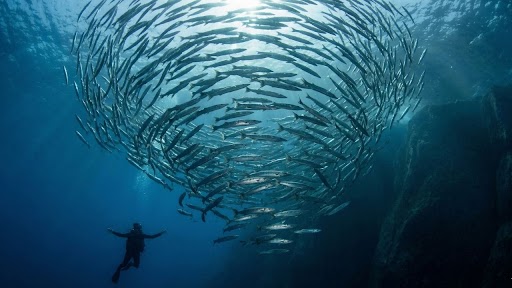
Because Sail Rock is in the open sea, it is hit by strong currents. And where there is current, there is food. So, you will often see “rivers” of Chevron Barracuda so thick they block out the sun.
And instead of hunting for small things in the cracks, you spend your sail rock koh tao diving experience looking out into the “blue.” This is where the Pelagics live. You’ll see Giant Trevally hunting smaller baitfish with surgical speed, and if you are lucky, the massive shadow of a Whale Shark gliding past the rock to scratch its belly on the granite.
Managing the “Washing Machine”
Diving here is different from the calm bays of the shoreline. You have to understand Current Management.
Sometimes the water hits the rock and creates an “Up-current” or a “Down-current.” What this means is that you might feel like you are being pushed toward the surface or pulled toward the bottom.
A professional diver doesn’t fight this. You learn to “hide” in the lee of the rock—the side where the water is calm. You use the granite as a shield, moving slowly from one side to the other to stay out of the heavy flow. This is the difference between an exhausting dive and a perfect one.
The Thermocline Divide
On a sail rock scuba diving trip, you might notice the water suddenly turn blurry and cold. This isn’t a problem with your mask; it’s a Thermocline.
This is where a layer of cold, nutrient-rich water from the deep ocean meets the warm surface water. The “blur” is caused by the different salt levels and temperatures mixing. To a diver, this is a good sign. The cold water brings the nutrients that attract the big hunters. When you hit the cold patch, keep your eyes open—something big is usually right behind it.
The Verdict
Sail Rock isn’t for people who want a quiet afternoon looking at coral. It is high-energy, high-stakes diving.
The site is unique because it pulls an entire ecosystem into one small space, giving you a direct look at how different species interact and survive in open water.
This is where you find out if you are actually ready for open-ocean diving. If you can handle the depth and the current here, every other site in the Gulf will feel easy by comparison.