
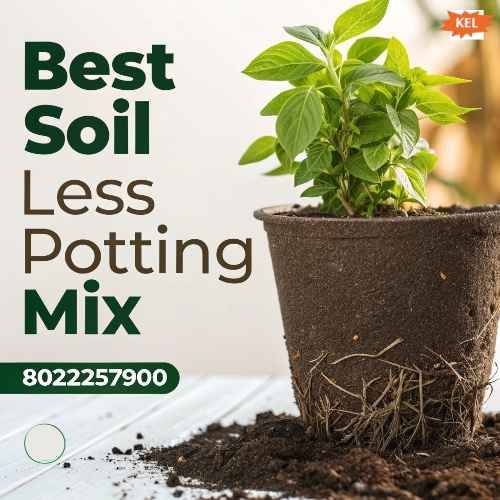
Modern growers are rethinking how plants are grown. Traditional soil is no longer the only option. From large scale greenhouses to terrace gardens, soil less cultivation is transforming productivity, consistency, and plant health. But the real question is simple. How do you choose the right soil less potting mix for reliable results?
This guide is written for growers who value performance, science, and long term plant health. Whether you manage a commercial nursery or grow vegetables at home, the right growing medium can define your success.
What is a soil less potting mix and why does it matter?
A soil less potting mix is a carefully engineered blend of organic and inorganic components designed to support plant roots without natural soil. It delivers structure, aeration, water retention, and nutrient availability in a controlled way.
Soil based media often suffer from compaction, pests, and inconsistent drainage. Soil less mixes solve these problems by offering predictable physical and chemical properties. This consistency is the reason professional growers rely on them.
Why are growers moving away from traditional soil?
Soil can vary widely in quality even within the same field or garden. It may contain pathogens, weed seeds, or heavy metals. For commercial growers, this variability leads to uneven growth and financial loss.
Soil less mixes eliminate most of these risks. They are sterile, lightweight, and optimized for root development. Home growers benefit too. Pots stay cleaner, plants grow faster, and maintenance becomes easier.
What makes the best soil less potting mix truly effective?
Not all mixes are equal. Performance depends on balance. The best soil less potting mix provides the right ratio of air, water, and nutrients while maintaining structural stability over time.
High quality mixes resist breakdown. They allow roots to breathe while holding enough moisture to prevent stress. This balance directly affects nutrient uptake, flowering, and yield.
Using the Best Soil Less Potting Mix ensures plants receive uniform support from seedling to harvest, reducing crop failures and improving overall plant vigor.
Which core components define quality?
Each ingredient plays a specific role. When blended correctly, they create a living environment for roots.
Coco peat improves water retention and promotes fine root growth. Perlite enhances aeration and prevents compaction. Vermiculite stores nutrients and releases them gradually. Some mixes also include composted organic matter to support beneficial microbes.
The quality of sourcing and processing matters. Poorly washed coco peat can introduce salts. Low grade perlite can collapse over time. This is why professional formulation is essential.
How does a soil less mix improve root health?
Roots need oxygen as much as water. In compacted soil, roots suffocate. In a well designed soil less mix, air pockets remain stable even after repeated irrigation.
Healthy roots absorb nutrients efficiently and resist disease. This leads to stronger stems, better leaf development, and higher yields. For commercial growers, this translates to uniform crops and predictable harvest cycles.
Is soil less growing suitable for both commercial and home use?
Absolutely. Commercial growers value scalability and consistency. Soil less mixes perform the same across thousands of containers, making automation and fertigation more effective.
Home growers appreciate ease of use. Containers stay lightweight. Drainage issues disappear. Plants respond quickly to care.
Whether you grow ornamentals, vegetables, herbs, or fruits, soil less media adapts easily to different crops and environments.
How does water management become easier?
One of the biggest advantages of soil less systems is water control. These mixes retain moisture without becoming waterlogged. Excess water drains freely, preventing root rot.
This efficiency reduces water usage and supports sustainable cultivation. In controlled environments, irrigation schedules become precise and repeatable, which is critical for commercial operations.
What role does nutrient control play?
Unlike soil, a soil less potting mix contains minimal inherent nutrients. This is a strength, not a weakness. It allows growers to control nutrition precisely through fertilizers or nutrient solutions.
Plants receive exactly what they need at each growth stage. This improves quality and reduces waste. It also minimizes the risk of nutrient lockout caused by unpredictable soil chemistry.
How does this impact yield and quality?
Consistent root conditions lead to consistent plant performance. Crops mature evenly. Flowering is uniform. Produce meets market standards more reliably.
For commercial growers, this consistency protects margins. For home growers, it means healthier plants and more satisfying harvests.
Using the Best Soil Less Potting Mix supports higher productivity without increasing labor or complexity.
Are soil less mixes environmentally responsible?
Yes, when sourced and formulated responsibly. Many modern mixes use renewable materials and reduce the need for soil extraction. Improved water efficiency also lowers environmental impact.
When combined with precise nutrient management, runoff and leaching are reduced. This makes soil less cultivation a smart choice for sustainable agriculture.
What should buyers look for when choosing a supplier?
Transparency matters. A reliable supplier provides clear information about composition, quality control, and suitability for different crops. Consistent batch quality is essential, especially for commercial use.
One example of a company focused on advanced growing media solutions is Keltech Energies, known for aligning material science with agricultural performance.
How do you transition from soil to soil less media?
Start small. Test a few containers or beds. Adjust irrigation and feeding practices gradually. Plants often respond quickly, but growers must adapt their routines.
Once familiar, most growers never return to traditional soil. The control, cleanliness, and results speak for themselves.
Is soil less cultivation the future of growing?
All signs point to yes. Urban farming, vertical agriculture, and protected cultivation all depend on soil less systems. Even traditional farms are adopting these mixes for nurseries and high value crops.
For growers who want consistency, efficiency, and healthier plants, soil less potting mixes are no longer optional. They are essential.
Final thoughts for serious growers
Growing success begins below the surface. Roots determine everything above. Choosing a professionally formulated soil less potting mix is an investment in plant health, yield, and long term sustainability.
When roots thrive, growers succeed.