
Most people looking into IT technician training courses think they are only going to work on sleek, new hardware. They imagine a world of M3 chips and high-speed fiber.
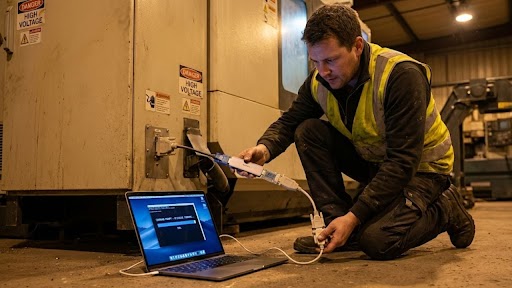
But when you walk into a hospital or a manufacturing plant, you realize the truth: the world runs on “Legacy.” You’ll find six-figure robotic arms controlled by computers that belong in a museum.
This is the real challenge of IT support specialist training. You aren’t just managing the new; you are building a bridge between 2025 and 1995. You are the person who understands how to make a modern cloud database “talk” to a thirty-year-old local server.
The Art of Hardware Emulation
When a critical piece of machinery relies on a port that doesn’t exist anymore—like a serial or parallel port—you don’t throw the machine away. You find a way to virtualize the environment.
What this means is you learn to create a “container” inside a modern computer. You run a virtual version of an old OS, so the machine thinks nothing has changed. It requires a deep understanding of BIOS/UEFI settings and interrupt requests (IRQs). It’s a specialized skill set that makes you the most valuable person in the room because you’re the only one who can keep the production line moving.
The Driver Conflict Dilemma
Automation ends when you deal with legacy hardware. A 64-bit kernel will usually reject a 32-bit driver for an old piece of equipment. You have to manually bypass security signatures or find a software wrapper just to get the computer to acknowledge that the machine exists.
What this means is you have to learn the art of Driver Signing Overrides. You’ll spend time in the Windows Test Mode to bypass the digital signatures that the modern OS requires for security. It is a calculated risk. This removes the digital signature requirement. The kernel stops blocking the driver. The raw instructions reach the hardware. This requires you to understand the Hardware ID (HID) and how to manually edit it.
The INF file acts as the coordinate map for the OS. You have to edit the file to force a connection between the legacy device and the modern motherboard. Without this step, the hardware is useless.”
The “Air-Gap” Security Protocol
Sometimes, the best way to fix a system is to keep it away from everything else.
In high-security environments, you’ll encounter “Air-Gapped” systems. These machines lack any physical connection to an outside network. There is no Wi-Fi card, no Ethernet cable, and the USB ports are often physically disabled to prevent data leakage.
So, you have to revert to manual diagnostics. You have to carry your tools on a physical drive and understand command-line syntax to repair the file system from the inside out. You cannot search for answers on the fly. If the fix isn’t in your head or on your drive, the system stays down. You are the only available resource in the room.
Deciphering Proprietary Logic
Modern IT is standardized. Legacy IT is “Proprietary.”
You’ll encounter systems where the “Manual” was lost in a flood in 1998. This is where you use Packet Sniffing to see what the machine is trying to say. You watch the data move across the wire to figure out the “Handshake” it expects.
You end up being the person who holds the keys to the entire operation. While others can support the new hardware, you are the only one capable of maintaining the legacy systems that actually generate the revenue.
The Critical Infrastructure Specialist
While the tech world moves fast, the change of critical infrastructure moves slowly. learning and mastering the legacy systems adds another skill set that makes sure you aren’t just another technician.
You are the specialist who ensures the revenue keeps flowing by keeping the machines alive. In this environment, uptime is the only thing that justifies your paycheck.